Where Rain Goes After It Reaches a Tree Pit
Follow rain through an urban tree pit to see how kerbs, openings and soil shape its route, and what a street layout can do to keep water moving.
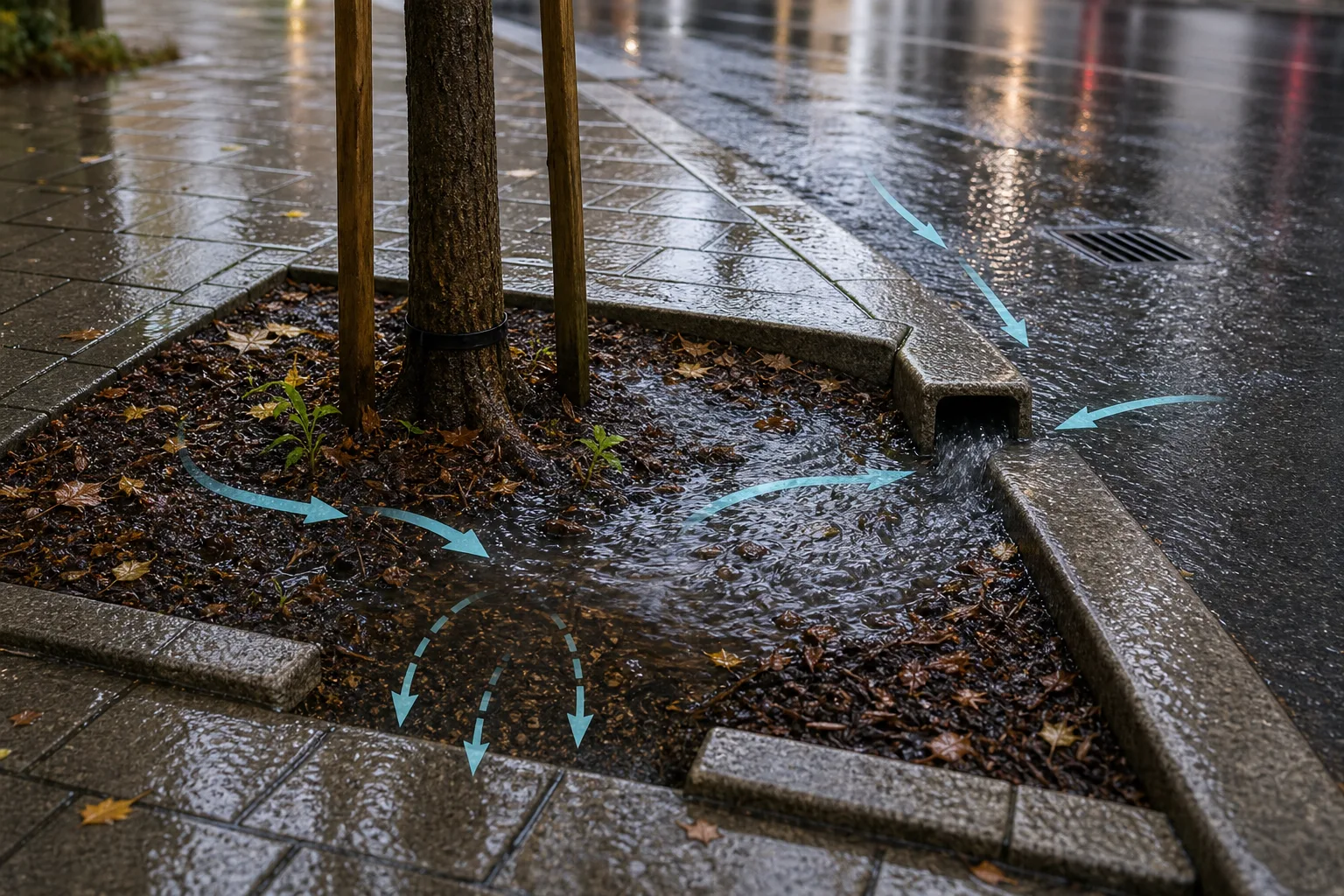
Rain entering a tree pit can soak into the soil, run across it, or arrive from the street through a kerb opening. Where it goes depends on the pit’s surface layout and the condition of the ground below, not simply on the presence of a tree. Follow one invented, hypothetical street pit through a storm and its aftermath, and the routes become easier to see.
Imagine a young tree growing in a paved neighbourhood street. Its square pit has a low kerb opening on the uphill side, a layer of mulch around the trunk, and compacted paving on three sides. During rain, runoff from the footpath and road gathers at the opening. Some enters the pit; the rest continues along the kerb towards a street drain.
That small scene raises practical questions: does the incoming water spread over the soil or collect in one spot? Can it move down through the root zone? Does excess water have a safe route away? The answers depend on how the pit is built, how well its soil drains, and whether the surrounding surface directs water towards or away from it.
The first arrivals
Rain reaches a tree pit by more than one route. It falls directly onto the exposed soil or mulch, runs from nearby paving into a low opening, or drains from a connected surface such as a footpath. A pit designed to receive street runoff may collect far more water than the rain that falls on its own small footprint.
In the imagined street, the kerb opening acts as an inlet. The sloped road surface guides a shallow sheet of water towards it. Leaves and grit ride along, so the opening must remain clear enough for water to enter rather than being blocked by debris.
Surface design determines how that arrival is handled. A broad, shallow inlet can spread incoming flow across more of the pit; a narrow gap can concentrate it in one place. A raised edge, an unbroken kerb or paving that slopes the wrong way can prevent runoff from entering at all.
Some pits use permeable paving or a grille around the tree. These materials can admit water, but their presence alone does not show where the water will go. Beneath them, compacted ground or a clogged layer can still slow movement, while gaps may admit sediment that gradually fills the surface openings.
Three routes down
Once water reaches the soil surface, it may follow several paths. The routes can happen together, and their balance shifts with soil texture, moisture, compaction and the rate at which water arrives.
- Infiltration: Water enters the surface and moves through pores in the soil. It may remain around roots for a time, be taken up by the tree and other plants, or continue downwards.
- Surface movement: Water travels across mulch or soil towards a lower edge. This can spread moisture across the pit, but a strong, concentrated flow may carry mulch or fine soil with it.
- Temporary storage and overflow: Water gathers in small hollows while it infiltrates. If it arrives faster than it can soak in, the level can rise and excess water may leave over a low edge or through a designed overflow route.
The pit in the example has a shallow depression, so the first water forms a thin pool near the inlet. Some moves through the soil; some fans out around the mulch. As the rain continues, the depression fills. If the soil cannot accept water as quickly as it arrives, the surface level climbs and the excess needs somewhere to go.
A well-considered overflow route matters because water should not be left to find its own way across a footpath, into a building entrance or around the tree’s trunk. Depending on the design, excess may return to the kerb, enter a drainage connection or spill towards another planted area. The route should be apparent in the layout rather than assumed.
Why soil changes things
Soil is not an empty container with identical pores from top to bottom. A loose, well-structured soil can let water enter and move through it more readily than heavily compacted ground. Fine-textured soil may hold water for longer, while coarse material can drain quickly; actual behaviour also depends on how the soil was placed and what lies beneath it.
Construction can alter the route. Heavy machinery may press soil into dense layers, and a sharp change between imported planting soil and the original ground can slow movement at their boundary. A pit may therefore appear to have loose soil at the surface yet hold water above a compacted or poorly draining layer below.
Water also changes soil as it travels. Runoff can bring grit, leaf fragments and sediment into the pit. If these settle over the surface or lodge in a permeable layer, entry may become slower. A stream that repeatedly cuts through one patch can expose roots or carry soil away, leaving a small channel rather than an even spread of moisture.
For the young tree in the invented scene, a brief pool after rain does not by itself reveal whether the design is working. The useful clues are what happens next: whether water gradually recedes, whether it leaves through the intended overflow, and whether it repeatedly ponds at the same point. Persistent standing water or an eroding channel calls for closer assessment of the pit and its drainage conditions.
Reading the surface
Surface layout shapes both the volume of runoff entering and the way it spreads. A pit set slightly below the surrounding paving may receive water, but its edges must still guide that water without creating a trip hazard or allowing sediment to wash in unchecked.
Kerb cuts are common inlets for street runoff. Their width, position and approach slope influence whether water flows through them or bypasses them. A cut facing the direction of flow may collect runoff effectively; one placed above the local low point may see little water, even if it looks open.
Mulch can soften the surface, reduce direct impact from falling rain and help protect soil from being displaced. It should not be piled against the trunk, and its depth and placement need to suit local guidance. Loose mulch carried into an inlet can also interfere with flow, so the inlet and the surrounding surface should be considered together.
Grilles and permeable paving offer different trade-offs. A grille leaves an opening around the trunk but may collect litter; permeable paving distributes entry across a larger area but can lose permeability if its joints become clogged. Neither option replaces suitable soil below or a route for excess water.
In the hypothetical pit, the inlet sits uphill and the low edge is on the opposite side. That arrangement encourages water to cross the planted area instead of immediately escaping. If observations later show a narrow channel forming between those points, the surface could need adjustment to spread flow, protect the soil or direct excess more reliably.
What happens in the storm?
Continue the invented scenario. At the start of the shower, rain lands on the pit and nearby paving. The paved area sheds water towards the kerb opening, where runoff enters with a little grit. The mulch slows the shallow flow and helps it spread, while the soil begins to absorb water.
As rainfall continues, the incoming flow exceeds the pace at which the upper soil can take it in. Water gathers in the shallow depression. Some continues moving down through the soil, but the surface pool grows until it reaches the low edge. There, excess drains towards the intended street-side route rather than crossing the footpath.
After the rain eases, the pool recedes. The expected observable result is damp soil with no continuing stream of sediment and no water stranded in a deep hollow. If instead the pool remains for a prolonged period, or the same spot repeatedly cuts into a channel, those signs suggest the surface arrangement or soil below deserves inspection.
This is not a promise that every pit will behave in the same way. It is a way to trace the chain: surrounding surfaces deliver water, openings admit it, soil accepts some, and an overflow route handles what cannot enter at once. A weakness anywhere along that chain can change the result.
Common questions about tree pits?
Does all rain enter the tree pit?
No. Some rain falls directly into the pit, while some runoff enters through a kerb cut or permeable surface. Water may also pass the opening and continue along the street, especially if the inlet is blocked or poorly aligned with the flow.
Is a puddle always a problem?
Not necessarily: a shallow pool can form temporarily while water infiltrates. Repeated or lingering ponding, especially alongside erosion or water spilling onto the footpath, is a reason to look more closely at the soil and drainage route.
Can mulch stop water reaching the soil?
A suitable mulch layer generally allows rain to pass through while cushioning the surface. A thick, compacted or displaced layer may alter flow, and mulch washed into an inlet can obstruct it; keep it clear of the trunk and follow local planting guidance.
What should happen to excess water?
Excess should follow a deliberate, safe route that does not create a nuisance or damage nearby surfaces. The route might lead back towards the kerb or into a connected drainage feature, depending on the site design.
Lessons from one pit
The invented street pit shows why inspecting only the tree or only the surface can miss the point. Rain’s route is a sequence: the street directs it, the opening admits it, the soil slows or accepts it, and the low edge or drain carries away what remains.
For anyone assessing a tree pit, look at the whole sequence. Is the inlet clear? Does the paving slope towards it? Does water spread or cut a channel? Where can overflow go? Does the surface recover after rain, or does it remain ponded? These observations help identify whether the issue is at the entrance, within the soil or at the outlet.
Where the answer is unclear, especially if runoff reaches a building, creates a persistent hazard or appears to damage roots, ask the local parks, highways or drainage team to assess the design. Tree pits vary from street to street, and changes to kerbs, drainage connections or planting soil should follow the relevant local specifications.
To understand where rain goes after it reaches a tree pit, watch one modest shower from the kerb opening to the low edge, then check the surface as it dries. That simple trace can reveal whether the pit is receiving water, sharing it with the soil and giving excess a sensible way out.
Nearby subjects

Reading a Street Tree by Its Branch Pattern
Reading a street tree by its branch pattern helps you notice species, growth habits and pruning…
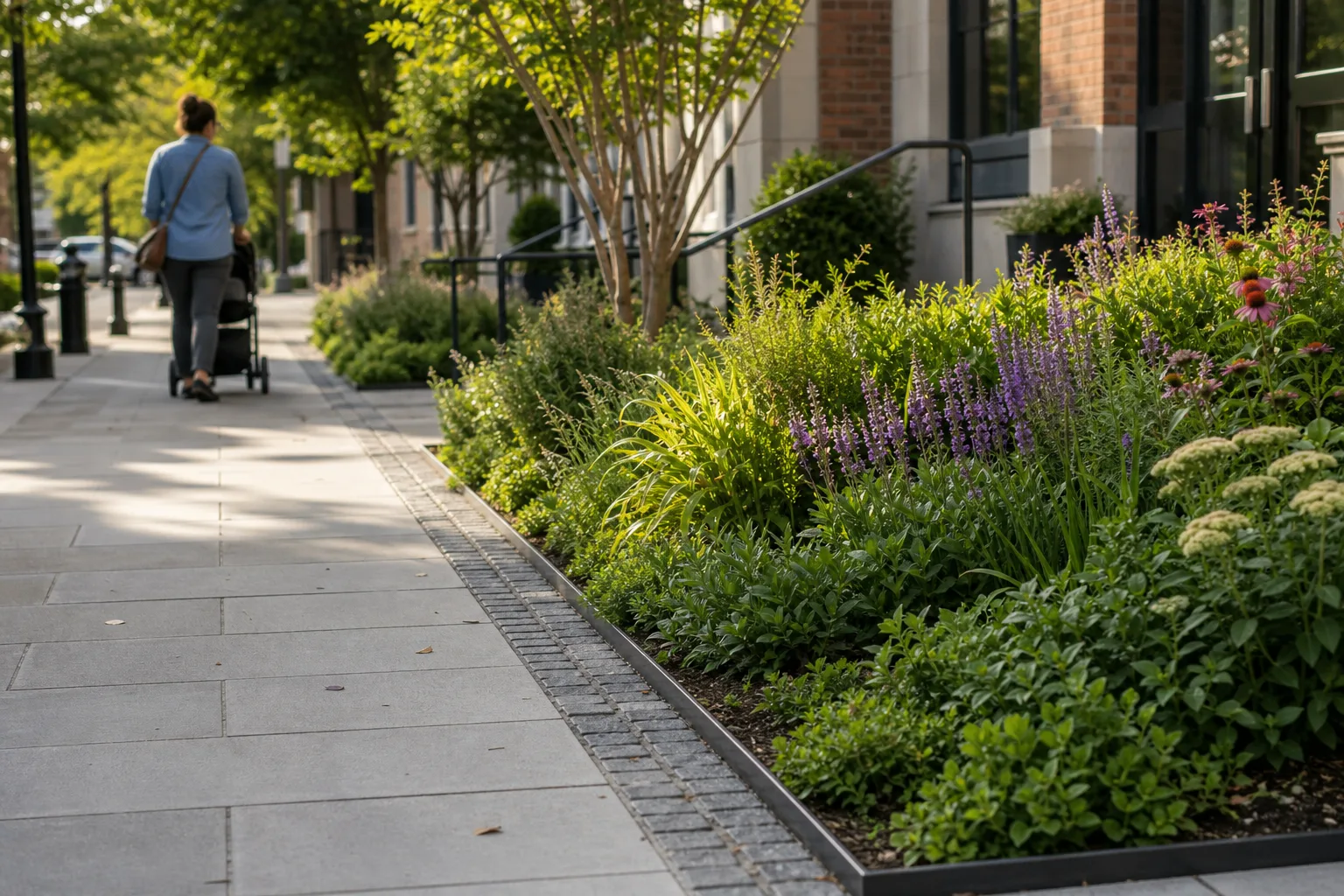
A Planting Bed That Meets the Footpath
A planting bed beside a footpath can add greenery without narrowing the route. Compare edge, planting…